
Imagine: in a parallel universe, Katherine of Aragon takes a different approach to the disappointments of her marriage to Henry VIII.
In 1517, at the age of 32, she is the mother of one daughter. She’s still young enough to have more children, to give her husband the son he needs to inherit his crown. But she’s had enough of Henry and the kingdom he rules. There are grounds – there are always grounds, if you look hard enough – to argue that the Church should rescind its permission for them to be married at all. She demands her freedom; and she leaves.
In this parallel universe, everything – everyone – is different. Katherine isn’t driven by an unflinching commitment to her duty and her faith. Henry’s ego is not so terrifyingly fragile that he can’t tolerate the world refusing to arrange itself according to his will. Above all, Katherine manages to find some kind of leverage to secure her escape, and some new home to live in. In a world where kings rule, how can a queen seize control of her fate?
It seems impossible. But three and a half centuries earlier, another queen in our own timeline had shown that it could be done.
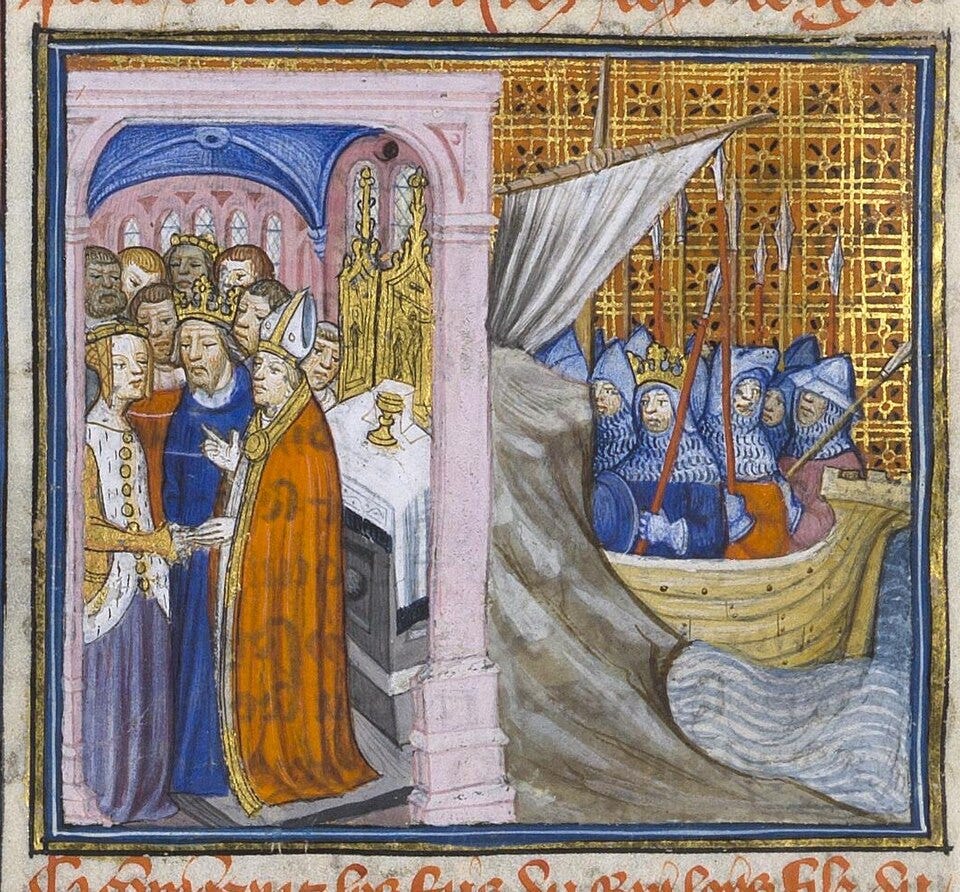
In 1152, at the age of 28, Eleanor of Aquitaine was the mother of two daughters. For fifteen years she had been married to Louis VII, king of France. She was still young enough to have more children, and to give her husband the son he needed to inherit his crown.
But there were grounds – there were always grounds, if you looked hard enough – to argue that the Church should rescind its permission for them to be married at all. In March of that year, an assembly of French bishops declared that Eleanor and Louis were too closely related to be husband and wife. As a result, their marriage was null and void.
Technically, the judgement had merit. Eleanor and Louis were related within the degrees of consanguinity prohibited by the Church, because they shared an ancestor within their families’ last seven generations.
On the other hand, so did most royal couples, given how interrelated the ruling families of Europe were and how small the pool of potential spouses. And only three years earlier Pope Eugenius III had forbidden any mention of consanguinity as a threat to the legitimacy of their marriage, which he proceeded to confirm ‘by word and writing’, and threatened anathema against anyone who sought to dissolve it.
So what had changed?
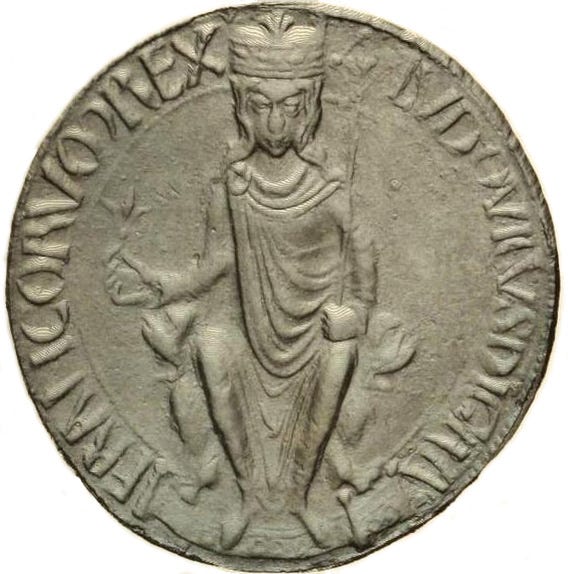
Historians have always agreed that the answer lies with Louis. Jane Martindale, in her excellent survey of Eleanor’s life for the Oxford Dictionary of National Biography, sums up the consensus:
There can be little doubt that both personal desire and dynastic need for a son were the motives underlying Louis VII’s decision to obtain a divorce in 1152 . . .
In some sense, of course it was the king’s decision. The bishops wouldn’t have gathered without his say-so, let alone declared the end of his marriage.
But here’s where I need to stand up and say: I disagree. Louis gave the order, but I doubt – a lot more than a little – that he was the moving force behind the annulment.
He did need a son. But Eleanor had given him two healthy daughters. The younger was only eighteen months old, and Eleanor herself wasn’t yet 30. There was no reason to believe she was physically incapable of giving birth in the coming years to a whole brood of boys.
And, between the two of them, it wasn’t Louis who had ever shown a desire to escape the relationship. When the pope declared their marriage valid in 1149, noted the well-informed observer John of Salisbury, ‘the ruling plainly delighted the king, since he loved the queen passionately, in an almost boyish way’.
It was Eleanor – not Louis – who had clearly had enough.
Never, since their wedding when she was just 13, had she seemed enthusiastic about her unimpressive husband. The suspicion was that her failure, so far, to give him more children than their two little girls might relate to the personal mismatch between his gauche religiosity and her worldly self-possession.
The breach between them came into public view when Eleanor accompanied Louis on crusade in 1147. Scandalous rumours flew around Europe about the intimacy that developed between the queen and her uncle Raymond of Poitiers, ruler of the principality of Antioch. When Louis gave the order to move on to Jerusalem, it was Eleanor – daringly and shockingly – who raised the issue of consanguinity to justify her refusal to go with him.
At that point, hundreds of miles from home, she didn’t win her freedom. Instead she was forced to submit to the ‘reconciliation’ brokered by the pope on their journey back through Italy, which resulted in the birth of their second daughter in 1150.
But there’s no sign that her feelings had changed; and, back in Paris, she still had an ace to play.
For a queen who wanted to leave – rather than a queen who assumed she must stay – the birth of another daughter had been the luckiest of breaks. Having a boy would raise the stakes dramatically: then, any further questions about the legitimacy of her marriage would also cast doubt on the legitimacy of the heir to France’s throne.
Not only that, but she would lose control of the inheritance she’d brought to her royal marriage, the great territories of the duchy of Aquitaine in the south-west of the kingdom, which would pass by right to any son she had with Louis.
To have a chance of making her escape, it was imperative that she should not conceive again. And not conceiving again was the best chance she had of making her escape. Louis needed a son and heir. If Eleanor remained his wife but refused to have sex with him, he would never have one.
Eleanor was more than capable of taking that stand – and isn’t it the most plausible explanation for the extraordinary facts we have?
We know, so far as we can for people who lived nine centuries ago, that Louis loved her. We know that, despite the scandal in Antioch, he wanted to continue the marriage. We also know that Aquitaine was a political and territorial prize of immense value to the French crown.
Yet, just eighteen months after their second daughter’s birth, he was prepared to let Eleanor go, and – should she have a son by any future marriage – Aquitaine with her.
These were huge sacrifices, worth making only if Louis saw no viable alternative.
Meanwhile Eleanor made no protest about the bishops’ decision. Their judgement affirmed the legitimacy of her two daughters, on the grounds that their parents had married in good faith. Otherwise, she left the girls behind without a backward glance.
Then, eight weeks and two days after the bishops had proclaimed her divorce, she married again. Her new husband was Henry, duke of Normandy and count of Anjou, a nineteen-year-old who had visited the French court seven months earlier. Less than two years after that, Henry was crowned king of England in Westminster Abbey with Eleanor, his queen, beside him. By then she had already given birth to the first of their five sons, and was pregnant again with their second. Aquitaine was now part of Henry’s empire; and Eleanor, once queen of France, was queen of England.
I can’t prove that the move to end Eleanor and Louis’s marriage originated with Eleanor herself. But it does make sense of what we know.
Unlike Katherine of Aragon, Eleanor had her own lands in Aquitaine which gave her another home to go to, and a rich inheritance to bring to a new marriage. Unlike Katherine of Aragon, she saw no virtue in a ‘reputation’ that trapped her in a situation she despised.
She had the freedom to act, rather than only react. And still, at this pivotal moment, accounts of her life leave agency in the hands of her husband. Here’s Ralph V. Turner’s biography of Eleanor:
Like Henry VIII of England almost 400 years later, Louis came to see his lack of male offspring as proof that God was frowning on his marriage and denying it divine blessing in spite of a papal dispensation. The birth of their second daughter confirmed this thinking and made invalidation of the marriage inevitable.
Perhaps that’s true – but there’s no direct evidence whatsoever of Louis’s thinking in 1152, and he showed no hesitation about marrying two more wives to whom he was equally or even more closely related.1
Why have we found it easier to join the dots this way than to imagine the possibility that Eleanor might have found a way to dictate terms in her own life?
Meanwhile, the source Turner cites in his footnote, an article by Marie-Bernadette Bruguière, says this: ‘From all the evidence, by contrast with Henry VIII of England later, he never saw in the absence of a male heir the divine punishment of an incestuous marriage (according to the terminology of the time).’
Hey Helen,
Thanks for this great newsletter. Back where I grew up in Kansas, we had a law about consanguinity... "If a husband divorces a wife, they are still cousins". 😂 We used to say in our family, "There will be no diving in our gene pool -- it is too shallow!"
For what it is worth, I agree completely with your analysis. Eleanor of Aquitaine was nothing if not decisive. Note how she escaped other pursuers to meet and wed Henry (eventually Henry II of England). Also look at how she conducted herself as Henry's wife. She was definitely a formidable woman of action.
I never considered how Louis might feel about this. Not only did he have a political rival in Henry but he must have burned with jealousy about how Eleanor preferred his rival. I guess it gave him something else to tell his confessor and for which to pray for forgiveness.
Thanks again for this newsletter.
Dr. Castor’s essays are always so incisive and thoughtful. The inclusion of the quote from Turner was very interesting— to see that the statements that Louis “came to see” and his “thinking was confirmed” were simply undocumented assertions illustrates the limitations of historical analysis in the long period before female historians became a greater part of the profession, and how valuable it is to now have the benefits of these enhanced viewpoints. Unfortunately, in the U.S., the current attacks on efforts to diversify university faculties is reducing the opportunities for developing different perspectives and interpretations.