
The Mildmay Identity
In which I find myself on a mission: from a London train to Elizabeth I's Chancellor of the Exchequer
‘Why’s it called the Mildmay Line?’ asked my Canadian husband one evening last week as we stood in a mercifully air-conditioned train carriage on what used to be simply the ‘London Overground’.
I answered without thinking: ‘Named after a 16th-century philanthropist.’
And then I stopped myself. What?
Because, well, it isn’t. A quick look at the map above our heads could tell me that.
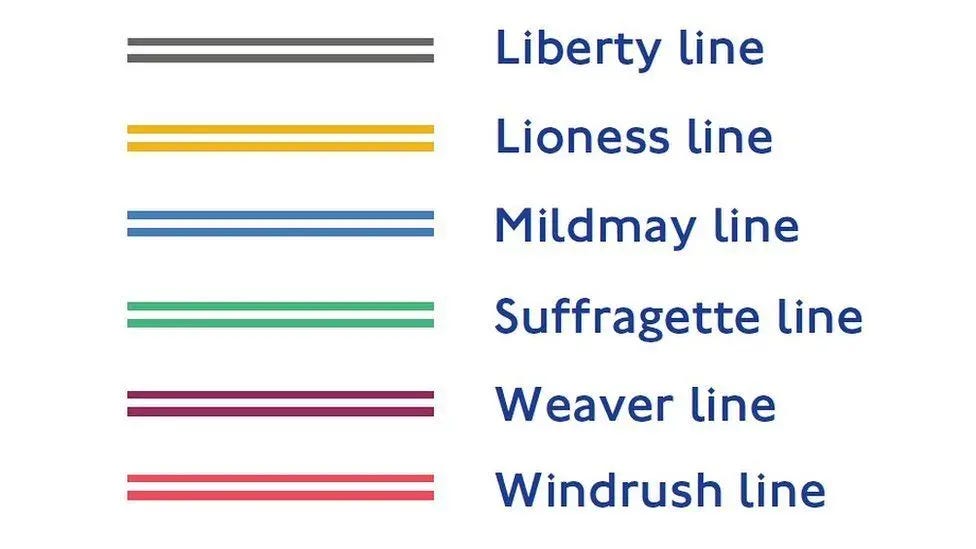
The new names given two years ago to the six lines of the London Overground are these: Liberty, Lioness, Suffragette, Windrush, Weaver and Mildmay. At first sight, it’s not easy to work out what links the names or precisely what they all signify, but there are enough clues in the composition of the group to suggest that ‘16th-century philanthropist’ isn’t likely to figure in the explanation.
Sure enough, when I turn to Transport for London’s 115-page booklet about ‘the story behind our project to name the London Overground lines’ (115 pages!), the 16th century might as well be ancient history.
London’s mayor explains that the ‘naming programme’ for the six lines was designed to ‘give Londoners the opportunity to tell more of our city’s diverse story and put some of our forgotten people and places back on the map’.
Some of the references are broad: to the suffragette campaign in the city; to liberty as a ‘defining feature’ of the capital; and ‘weaver’ for the layered history of London’s (now defunct) textile industry. Some are more specific: ‘Windrush’ for the ship that became a symbol of post-war migration from the Caribbean, and ‘Lioness’ for the England women’s football team who were champions of Europe in 2022.
And the Mildmay line? It honours the Mildmay, ‘a small but crucial charitable hospital serving the NHS in Tower Hamlets, with a long history of helping Londoners in need’, now ‘internationally renowned as a centre for caring for people with HIV and AIDS-related illnesses’.
So why did my brain go back 500 years?
I started tugging at the thread.
The Mildmay Hospital as it exists today dates back to the 1980s, when it was converted from a nursing home into a pioneering hospice for people with AIDS, the first of its kind in Europe.
But its ‘long history’ began a century earlier, with a woman named Catherine Pennefather.
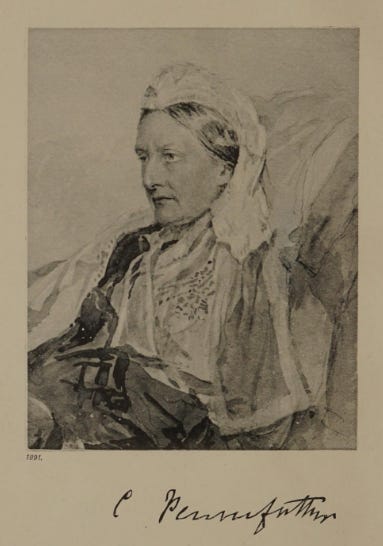
Catherine and her husband William, an Anglican clergyman originally from Ireland, devoted their lives to mission work in London. In the 1860s, among a huge range of evangelical and philanthropic initiatives, they set up an institution to train devout and educated women as ‘deaconesses’ – that is, uniformed missionaries to work full-time, at home and abroad, in caring for the poor and the needy, including as nurses.
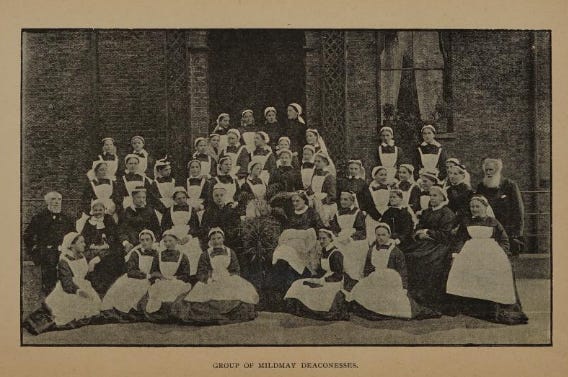
William, whose health had never been good, died in 1873 at the age of just 57, but under Catherine’s indefatigable direction their many projects continued to grow. In 1877, prompted by the local work of two of her deaconesses during the cholera epidemic of 1866, she opened a hospital between Shoreditch and Bethnal Green in east London, which moved to a brand-new building nearby in 1892, a year before Catherine died. It was this hospital that was incorporated into the National Health Service in 1948 and continued to serve the local community until 1982, when it was briefly closed before reopening as the nursing home that became the AIDS hospice.
So far, so impressive. But why the Mildmay Hospital?
It was the Mildmay Hospital because the Pennefathers named their lives’ work the Mildmay Mission – a choice they made because the church of St Jude and St Paul where William was vicar from 1864 until his death stood in an area called Mildmay Park in Islington, north London.
Harriette J. Cooke, an admiring American visitor (and former professor of history at Cornell), who came to observe the Mission’s activities at the beginning of the 1890s, found herself nonplussed – almost outraged on the Pennefathers’ behalf – by their decision.
It is rather puzzling to one seeking the beginnings of this institution to be told that the name Mildmay does not belong to it, but is simply the geographical name of the district in which the work has grown up. It ought to bear the name of the founders. But this is due to the extreme unwillingness they had to allow anything like letting ‘thy left hand know what thy right hand doeth.’
(To my shame, it turns out I’d never properly known what that phrase means; Harriette and the Pennefathers would be horrified. The reference is to the Sermon on the Mount, and Christ’s instruction (Matthew 6:3) that ‘when thou givest alms, let not thy left hand know what thy right hand doeth, that thine almsgiving may be in secret; and thy Father who seeth in secret, Himself shall reward thee openly’.)
Harriette Cooke’s account of the Mission, first published in 1892, gives a powerful sense of the huge scale of its operations, and the care and integrity with which Catherine and her deaconesses went about their work. In that year it had twenty-four different branches of activity – ‘missions, lodging-houses, homes, infirmaries, etc’ – and spent all of its donated income, more than £33,000, on its charitable purposes at an administrative cost of only £800.1
Harriette’s whole book is well worth a read, and full of surprises. (Did you know, for instance, that 1880s Northampton was ‘the very hotbed of atheism’? A particular challenge was presented by the number of shoemakers in the town, since the shoemaker, she says, ‘is a man who thinks for himself’. Not only that, but his trade allows him to talk while he works, which makes such free-thinking a problem now that shoes are made by workers ‘banded together in large factories’. Luckily the laying-on of a tea in the Mission’s lecture-hall – an event for which the deaconesses had paved the way with their steadfast work among the sick and the destitute – encouraged these recalcitrants into listening to the gospel. After all, ‘if a “Tea” will not attract a class of English working men, you may consider it hopeless!’)
But she has much less to say about the reasons why Mildmay Park – and therefore the Mildmay Mission – are called Mildmay. She knows that by the mid-19th century the Park – which had once been a country estate – was being taken over by London sprawl. Much of it was scattered with brick-kilns and building-sites, from which new streets of terraced houses were starting to rise. They’re still on the map: not just a street named Mildmay Park, but Mildmay Road, Mildmay Street, Mildmay Place, Mildmay Grove and Mildmay Avenue.
She also knows that the name belonged to some previous owners of the land,
… though we cannot learn that the Mildmay family have ever done anything for the work which perpetuates their name. It is to be hoped they will, in gratitude, remember the work which sends their name into all parts of the world with a fragrance upon it that no title could give.
But should the Mildmays be so quickly dismissed as freeloaders, raking in unearned recognition on the back of the Pennefathers’ selfless enterprise?
Time to tug again at the thread.
