
Succession
Richard II, Matilda, and other Roys
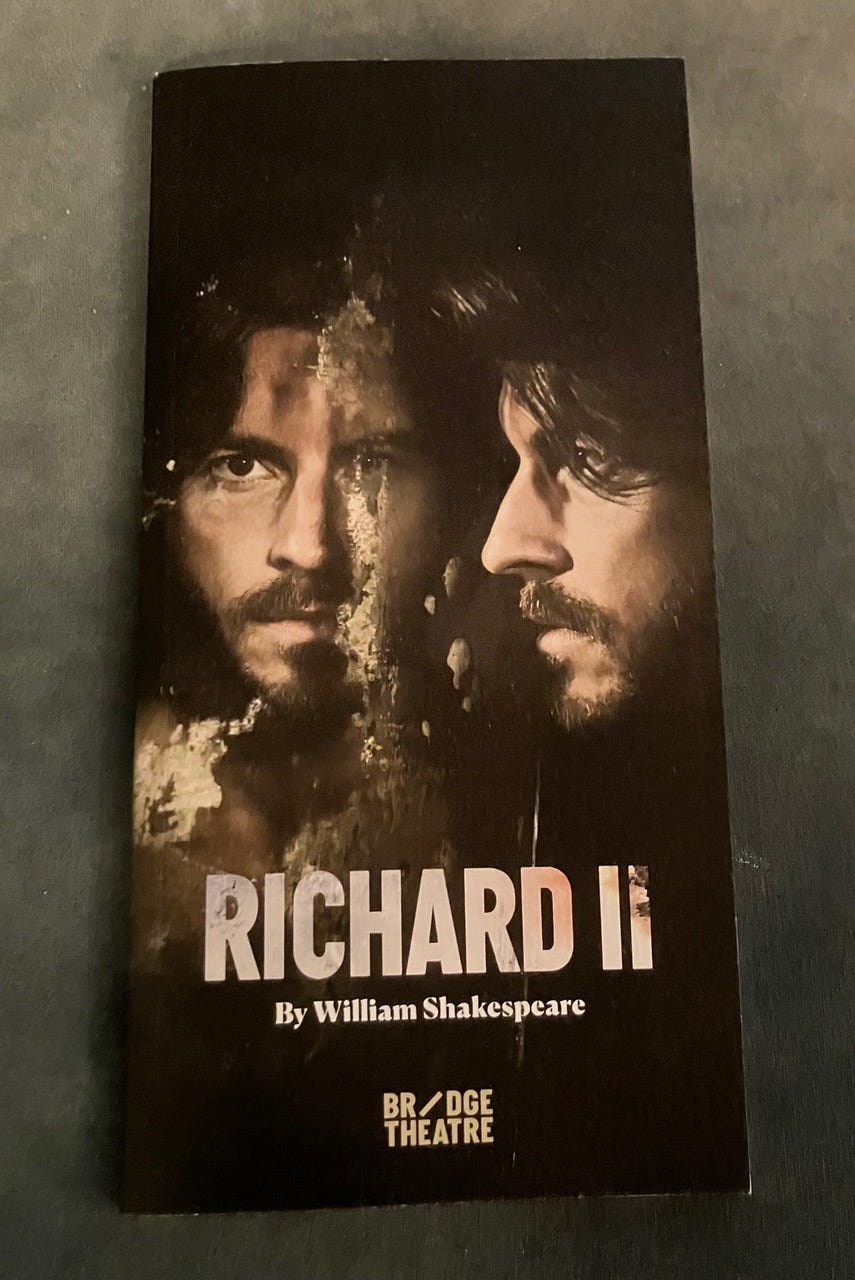
Last week I saw this wonderful thing. Not just the programme – wonderful though that is (especially since they let me write about history in it) – but Nicholas Hytner’s remarkable production of Shakespeare’s Richard II at the Bridge Theatre in London.
It’s a production of extraordinary political and emotional clarity, as well as sharply entertaining wit. Jonathan Bailey’s Richard is mesmerising: brittle, chaotic cruelty giving way, in the end, to a lucid, helpless grace.
And there were two elements of the play’s opening scene that struck me particularly. One was its design.
We find ourselves in Richard’s study, where the heavy black doors and huge desk are lavishly decorated with rococo motifs in gold that to me – although, disclaimer, I’m no fashionista – screamed Versace. I’d have loved it even if I hadn’t just that same week written a piece comparing Richard name-checking Homer on his tomb to ‘VERSACE’ on a handbag.
So, fashion vindication; but also – the second thing – televisual allusion. Grant Olding’s score for the play is a pitch-perfect homage-stroke-pastiche of Nicholas Britell’s outrageously brilliant theme music for Succession, HBO’s drama about the fate of Logan Roy’s fictional media empire.
Succession’s script is dizzyingly saturated with historical and cultural references (like a highbrow Buffy the Vampire Slayer, which itself got a subliminal nod in one of the climactic episodes of the final season).
Its range is omnivorous. The mirror it holds up to the Murdochs is so devastatingly precise that life has started imitating art-imitating-life – but Kennedys, Carnegies, Redstones and more are refracted here too. There’s classical myth and ancient history; shades and metatextual echoes from Dickens and Chekhov to John Berryman’s Dream Songs and creator Jesse Armstrong’s own Peep Show.
And Shakespeare, always Shakespeare: Hamlet, Macbeth, Julius Caesar, Coriolanus, Richard III and – overwhelmingly – King Lear. Logan Roy’s surname, after all, is the metaphorical prime directive. When the king is dead, who will wear the crown?
Unsurprisingly, it turns out that Richard II works too. What damage is done when a king is a megalomaniac sociopath? And what damage might be done in the attempt to unseat him?
But this medieval parallel got me thinking about, well, succession. Specifically, about the benefits and drawbacks of settling on a fixed system of inheritance by primogeniture.
Logan (probably) wants his bloodline to continue on the corporate throne of Waystar Royco, but in his world of shareholders, mergers and hostile takeovers there’s no rule or regulation to say which, if any, of his children should be his heir. The Anglo-Saxons would have recognised his dilemma. By their tradition, the magnates of the kingdom chose their king from among the men of royal descent – an opportunity for the judicious weighing up of talents that had the unfortunate habit of descending into a bloodbath, as candidates for the throne battled to demonstrate their kingly ruthlessness by killing or maiming their rivals. The Roys would have recognised their difficulty.
Richard, meanwhile, is king of England because he’s the only legitimate son of the eldest son of the previous king. When the play begins he’s thirty-one, but he had inherited his crown at ten, without a hint of conflict about his status as the ‘true heir apparent of the realm’. In his case the problem is that his personal qualities make him entirely – and dangerously – the wrong man for the job. But because he has the unquestioned right to the throne, there’s no way to remove him without massive risk to the whole kingdom.
In either system, though, women are at a substantial disadvantage. Male heirs to the English (and then British) crown had automatic precedence over female ones from the twelfth century, when the principle of royal primogeniture took hold in England, until the Succession to the Crown Act of 2013. And, as Shiv Roy discovers, it’s not easy to demonstrate your credentials for the top job in open competition when you’re swimming against a tide of deeply embedded assumptions that power is – historically, culturally, naturally – male.
The more I thought about it, the more Shiv’s situation in Succession’s last season reminded me of Henry I’s daughter Matilda in 1135. (Spoilers ahead: anyone who hasn’t yet watched Succession should go and do so right this minute.)
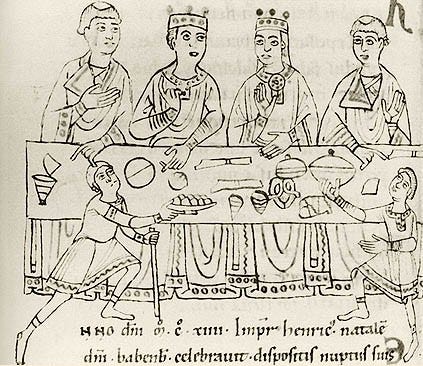
Unlike Shiv, Matilda was her father’s chosen heir. After the drowning of her younger brother William in the wreck of the White Ship, Henry demanded that his magnates swear allegiance to Matilda as his successor not once, but twice. The very fact of this repeated oath-taking, however, signalled uncertainty about whether the rule of a woman would be accepted once Henry was no longer there.
Like Shiv, Matilda was complicatedly married to a man of less power and lower status (her second husband Geoffrey of Anjou). And, like Shiv, when her father died suddenly, she was pregnant.
In Matilda’s case, her pregnancy pinned her in the wrong place, stranded in Normandy while her cousin Stephen raced for England to seize the crown. Shiv, on the other hand, is adamant that the physical demands of motherhood won’t slow her down, not even for a second. (‘“She’s one of those hard bitches, right?” she says sardonically. “She’s gonna do thirty-six hours of maternity leave, emailing through her vanity caesarean. Poor kid’ll never see her.”’)
For neither of them was pregnancy primarily their own choice. It served instead to provide their fathers with a potential male heir for the future, and to embed their husbands within the power structures they themselves embodied.
And for both of them, pregnancy made their problematic femaleness undeniable and unignorable. One brutal exchange between Shiv and her brother Kendall exposes the visceral heart of the issue. It’s couched in very strong language, and – even though they’re not talking about the fact of her sex – the language tells its own story.
Shiv: You grabbed the crown and pushed me out. So I don’t know why I’m the cunt here.
Kendall: Cunt is as cunt does.
In the end, both Shiv and Matilda have to accept that the crown is still shaped for a male head; that they must take a step back, to stand behind a husband or a son.
It’s getting on for a thousand years since the Conquest of 1066, and in that time forty-two monarchs have sat on England’s throne. Six have been women, of whom four wore the crown when the sovereign still ruled rather than reigned. Not one of those four was succeeded by a child of her own.
As Richard and the Roys can tell us, succession is never simple. But if I were a betting woman, history tells me I should always bet on a man.
Oooof, drawing comparisons between the Plantagenets and Succession is just excellent. I might very well be able to use this article to get my Succession-obsessed partner into Richard II!
I love Succession and Richard II, but hadn't twigged that they illustrate the flaws/advantages of primogeniture. (Though in a way the Roys are all so appalling it wouldnt matter what system was in place, or which child of whichever sex ended up in power.) I did myself write a post all about primogeniture, Bridgerton and Jane Austen! Its a system of inheritance that's shaped history and literature I guess, in fundamental ways.