
Blak Monday
a ffoule Derke day off myste and off haylle
Black Friday, Blue Monday, Ruby Tuesday… When did we start putting colours and days together?
I first came across a reference to a medieval day called ‘Black Monday’ when I was leafing through a chronicle of London in English that was compiled, from some earlier source, during the opening decades of the fifteenth century.
The entries for the thirteenth century are brief, consisting of little more than the names of key officials in the city. Pleasingly, English cultural preoccupations don’t seem to have changed over more than half a millennium, because the few detailed notes that appear between the lists of names are mainly about the weather.
Here’s one for 1202:
In this same yere, that is to say the yere off oure Lorde MCCij, there were greete Reynes and eke Thundres. And also there ffylle grete Hayles, ffor ther kome adovne with the Reyne out of the eyre hayle-Stones ffoure Squayre, as grete as eny eyren; wher thurh bothe Trees, Vynes and Cornes were ffully dystroyed, and men were sore afferde.
In this same year, that is to say the year of Our Lord 1202, there were great rains and eke [also] thunders. And also there fell great hails, for there came down with the rain out of the air hailstones four-square, as great as any eyren [eggs]; wherethrough [through which] both trees, vines and corns were fully destroyed, and men were sore afeared.
At times our chronicler’s commitment to making the weather the main headline, no matter what the rest of the news might be, is yet more impressive. Here’s his report on 1216:
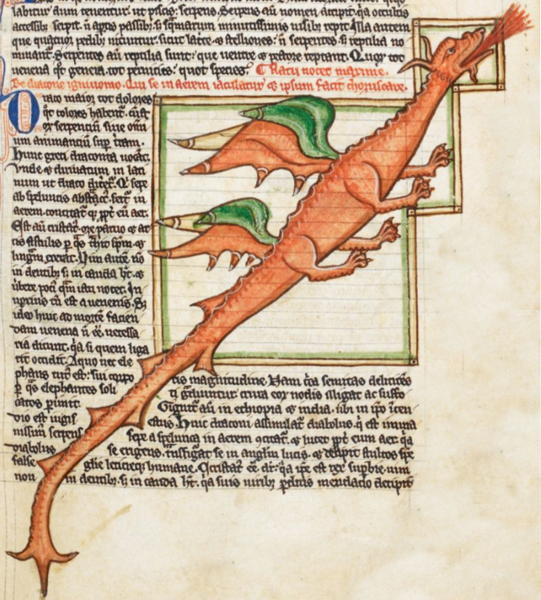
In this same yere, that ys to say vpon Seynt Lukys Day, there Blewe a grete Wynde out off the North Est, that ouerthrewe many an house and also Turrettes and Chirches, and fferde ffoule with the Woddes and Mennys Orcherdes. And also fyrye Dragons and Wykked Spyrites weren many seyn, merveyllously ffleynge in the eyre.
In this same year, that is to say upon St Luke’s day, there blew a great wind out of the north-east, that overthrew many a house and also turrets and churches, and fared foul with the woods and men’s orchards. And also fiery dragons and wicked spirits were many seen, marvellously flying in the air.
When we reach the fourteenth century, the weather finally takes a back seat to some gathering horsemen of the apocalypse: not just plague and famine but war, specifically the decades-long conflict precipitated by Edward III’s attempt to claim the throne of France.
But when he gets to 1360, the chronicler finds himself with an opportunity to turn his spotlight on both war and weather, in an unmissable double whammy:
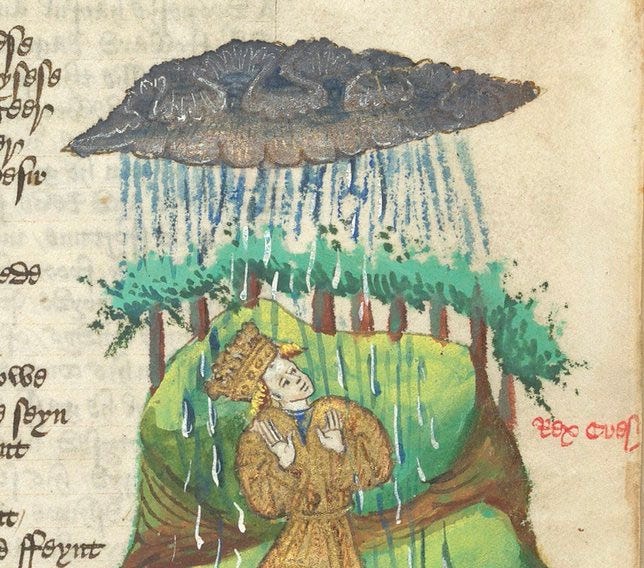
In this same yere, the xiiij day of Aprill and the morwe after Ester Day, Kyng Edward with his Oost lay byfore the Citee off Parys; the which was a ffoule Derke day off myste, and off haylle, and so bytter colde that syttyng on horse bak men dyed. Wherfore, vnto this day yt ys called blak Monday, and wolle be longe tyme here affter.
In this same year, the 14th day of April and the morrow after Easter Day, King Edward with his host lay before the city of Paris; the which was a foul dark day of mist and of hail, and so bitter cold that, sitting on horseback, men died. Wherefore, unto this day it is called black Monday, and will be long time hereafter.
Is this incident our origin story for the habit of using colours to characterise specific days of the year?
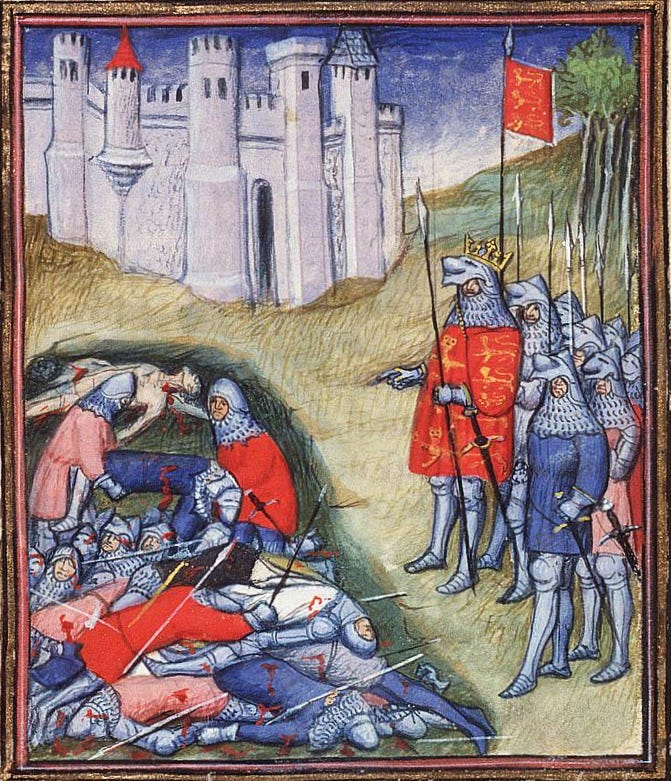
A whole range of evidence from contemporary chronicles tells us that, shortly after Easter 1360, Edward III’s army – the biggest he’d raised in more than a decade, and ‘probably the most impressive that had ever left England’s shores’, Jonathan Sumption writes – did suffer devastating losses because of a sudden freezing storm.
The winter of 1359-60 had been relentlessly cold and wet, but in March the skies had cleared and, as they advanced on Paris, Edward’s soldiers found themselves riding under a warm sun.
Then, after six weeks of spring, without warning, the weather turned. Thunder rolled overhead. Ferocious winds drove lashing rain through clothes to the skin. The ground turned to mud. Wheels sank and then stuck; wagons full of tents, equipment and stores were left where they stopped. The temperature dropped, and the rain became sleet, then froze solid. Thousands of men and horses died. Some succumbed to the cold. Others were killed by massive hailstones. Guy Beauchamp, the heir to the earldom of Warwick, was so badly injured that he died two weeks later.
That much, all the sources tell us. But on closer inspection our London chronicler leaves us with problems.
One is the location of the narrative. When the storm struck, Edward and his army were no longer ‘byfore the Citee off Parys’. Instead, they were brutally exposed on the plain south-west of the capital, on their way to Chartres.
The place is wrong; but so are our chronicler’s two attempts at the date. Easter Sunday in 1360 fell on 5 April. ‘The morwe after Ester Day’ was 6 April. The Monday after that was 13 April. So 14 April – the date with which the whole story is introduced – was a Tuesday: neither the day after Easter nor a Monday at all.
Our Londoner isn’t the only one to have trouble with the calendar. The Scalacronica, written shortly after the events of 1360 by the Northumbrian knight Thomas Grey, places the storm on ‘Sunday 13 April’. Given that the Sunday in question was 12 April, either Grey’s day or his date could be right, but not both.
Meanwhile, the Historia Anglicana of Thomas Walsingham agrees with Grey on the day of the week – the text gives the ‘Octave of Easter’, which is the Sunday after Easter Sunday (ie the eighth day after Easter, counting Easter Sunday itself) – but avoids tripping itself up with any attempt at a numerical date.
It’s the anonymous author of the Anonimalle Chronicle, a fourteenth-century history written in French at St Mary’s Abbey in York, who – when cross-checked with the wider information we have about the chronology of the campaign – gets it right: the storm broke, not on Easter Monday, but on the Monday after Easter week, that is, Monday 13 April.
And it’s also the Anonimalle Chronicle that gives our only other report of how contemporaries referred to this fateful day:
… cest adire le mauveys lundy et bien appelles mauveys lundy …
… that is to say, Bad Monday, and rightly called Bad Monday …
So how do we get from this fourteenth-century ‘Bad Monday’ to our fifteenth-century ‘Black Monday’?
In fact, the Monday on which the storm fell already had its own name: ‘Hock Monday’, meaning the Monday in ‘Hocktide’, the two days immediately following the ‘Octave of Easter’. It was a time in which money was collected by the parish through festive customs and games, but we have no idea where the name comes from. Its etymological entry in the Oxford English Dictionary is brilliantly dismissive of the current state of knowledge:
Few words have received so much etymological and historical investigation as Hock-day, Hocktide, Hock Tuesday, Hock Monday. But the origin has not yet been ascertained. Early evidence shows that the first element was originally disyllabic, hoke–; but whether the o was long or short is not determined; it was evidently short when subsequently spelt hocke–, hokke–. Hock-day, which is the earliest of the group (Hock Tuesday appearing next), has not been found before the 12th cent.; no trace of it appears in Old English or any Germanic language. Skinner’s conjecture that Hock-tide might be the Middle Dutch hogetide, hoochtide, ‘high time, festival, wedding’, is out of the question, and Lambarde’s explanation of hock as for Old English hocor, ‘mockery, scorn, derision’ (repeated by Speed, Blount, Phillips, Bailey, etc), is on many grounds untenable.
One has the feeling of having intruded into the middle of a raging argument, and that it might be better to close the door quietly and tiptoe away.
But it also turns out that ‘Black Monday’ was a name already in use, and already attached to Easter Monday, before our London chronicler adopted it for the Monday of the storm.
The OED is, again, invaluable. The first thing it offers is a warning:
The historical explanations given … in the quotation evidence are unreliable.
And what’s the first of the quotations suggesting an unreliable explanation? Our Londoner himself.
(The other historical explanation is the killing of English settlers in Dublin by the Irish on Easter Monday in 1209, but that’s not reported as ‘Black Monday’ until 1604.)
So what did ‘Black Monday’ originally mean?
A popular belief in the unlucky character of Mondays is attested in British sources from the Old English period onwards. Three Mondays were considered particularly unlucky: in post-classical Latin as well as Old English sources, these are given as the Monday after 25 March (or in Old English sources the last Monday in April), the first Monday in August, and the last Monday in December. … It is possible that the common notion that rejoicing is naturally followed by calamity may have caused Easter Monday to be regarded as even more inauspicious than other Mondays.
It looks likely, therefore, that Easter Monday was already ‘unlucky’ well before our Londoner decided to retrofit the date of the storm.
And it also seems that, by the late fourteenth century, ‘Black Monday’ was commonly enough understood simply as an alternative name for Easter Monday that it could be used even in circumstances where no implication of ill luck was intended. In the ordinances of the gild of St Nicholas in West Lynn in Norfolk, for example, which was founded in 1359, it was decreed that there should be four gild meetings a year, of which ‘ye secunde schal be on blake monunday’.
This evolution from ‘a day that’s unlucky because it follows a celebration’ into ‘a day that’s called Black Monday because it always has been’ might also help us with the vexed question of where our contemporary ‘Black Friday’ comes from.
There are a number of proposed explanations for the name, to do with a variety of unfortunate events, but the one certainty is that Black Friday falls on the day after Thanksgiving has been celebrated in the United States. We’re back to ‘the common notion that rejoicing is naturally followed by calamity’.
But, like the medieval ‘Black Monday’, the date has taken on a life of its own. There’s no obvious reason why the current meaning of Black Friday as ‘the day Christmas shopping starts in earnest with huge discounts available in shops and online’ should be related to any sense of bad luck. And outside the US, Thanksgiving either doesn’t exist as a holiday or takes place on a different date, so over here in the UK, for example, there’s no ‘Thursday rejoicing’ going on for any atavistic sense of ‘Friday calamity’ to follow in any case.
This year, I’ll just be grateful if no hailstones as big as eggs are involved. Happy shopping!
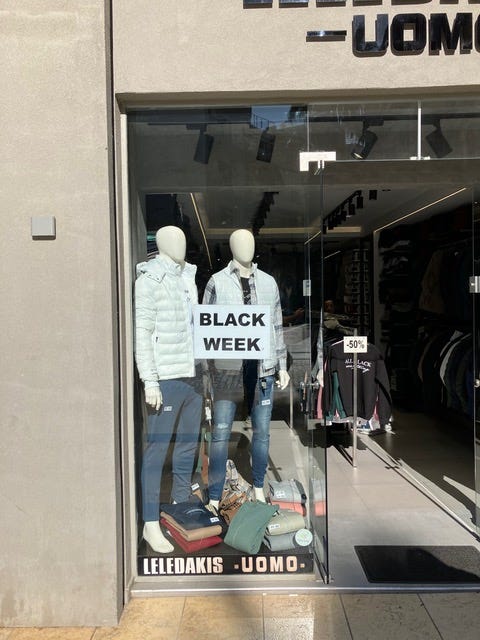
Edit: these just in from Greece – the evolution continues…

Great essay. I enjoy when issues are not totally resolved and future generations must continue to add their perspectives.
Regarding Black Friday in the US, I remember reading long ago that retailers looked to the day as time to get "into the black" with sales for the rest of the year. Not doing so might be the end of a business. And does the UK have Black Friday shopping madness despite not having Thanksgiving?
I have always assumed that Black Friday comes from the fact that, before the Internet, in the US, Black Friday shopping meant waking up at oh-my-God-o' clock the day after giving yourself tryptophan poisoning, and the going to stand in line for the hours so that you could buy a tv very cheaply (fortunately, not a tradition my family observed). I have a clear memory of going to Best Buy at 9 am on Black Friday, and my mother getting in line immediately after we got there. My father, my brother, and I went and fetched the things on our lists. We all pretended we couldn't see what everyone else was picking up. There hours later, we finally had our purchases made, and or was a decade before my mother willingly entered a Best Buy again (she still about it, and it's been 30 years).
But I'm fascinated by the history of colors + days, and the vagaries of language, dates, and memory.